
Taking Action
What are Areas for Action?
An Area for Action is a term used in Ireland’s River Basin Management Plan to describe focused work that helps protect and improve water quality. It promotes collaboration and knowledge sharing across communities and agencies.
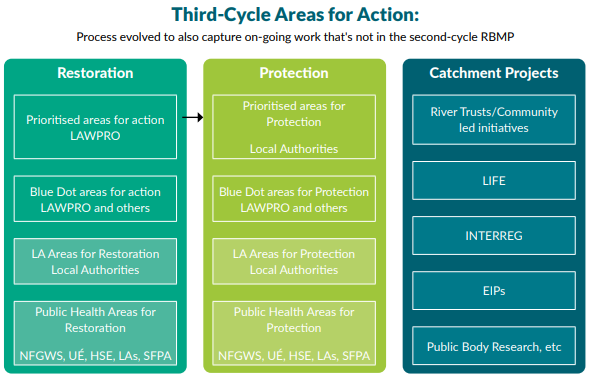
For the third cycle (2022–2027), Areas for Action are grouped into three categories:
- Areas for Restoration – target ‘At Risk’, and sometimes ‘Review’ water bodies
- Areas for Protection – places where good water quality needs to be maintained
- Catchment Projects – large-scale projects that deliver water-quality benefits
This broader approach builds on the Priority Areas for Action used in the second cycle (2018–2021), which focused on the most at-risk waters. The third cycle expands this to give “a place in the plan for everyone” by including restoration, protection, and catchment-scale initiatives.
Third-Cycle Areas for Action Framework
Each Area for Action has a designated lead organisation, such as LAWPRO, a local authority, the National Federation of Group Water Schemes, or Inland Fisheries Ireland. This framework aims to bring together all water-quality improvement work happening across the country. It also aims to align actions carried out for other purposes with the objectives of the River Basin Management Plan (RBMP), wherever possible, so that synergies are identified and multiple benefits achieved.
All other water bodies will benefit from the implementation of basic measures as part of each organisation’s annual work programmes. This process supports a collaborative approach across agencies, with activities delivered in line with integrated catchment management. It also creates opportunities for organisations to learn from one another and helps build an evidence base on actions that successfully restore and protect water quality.
Areas for Action progress updates
You can find updates on the progress in each Area for Action on catchments.ie. To see updates, follow the instructions outlined below.
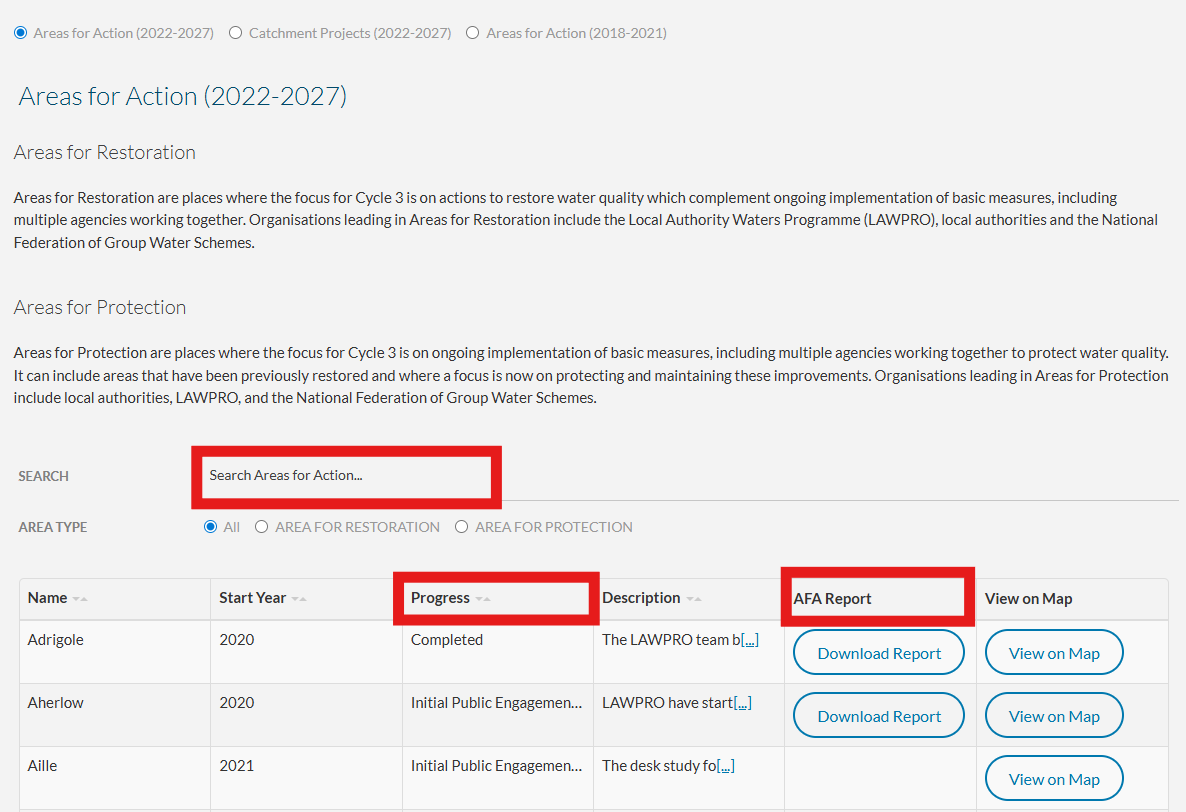
1. Find your Area for Action – Name Search
This method is best for those who already know the name of their PAA. Catchments.ie provides a search function to allow you to easily list PAA’s of interest. From this screen you will be able to:
- See the current Progress status
- A description of the Progress
- Download a plain Desk Study Summary report
- View the location on a Map
2. Find your AFA – Water Map Search
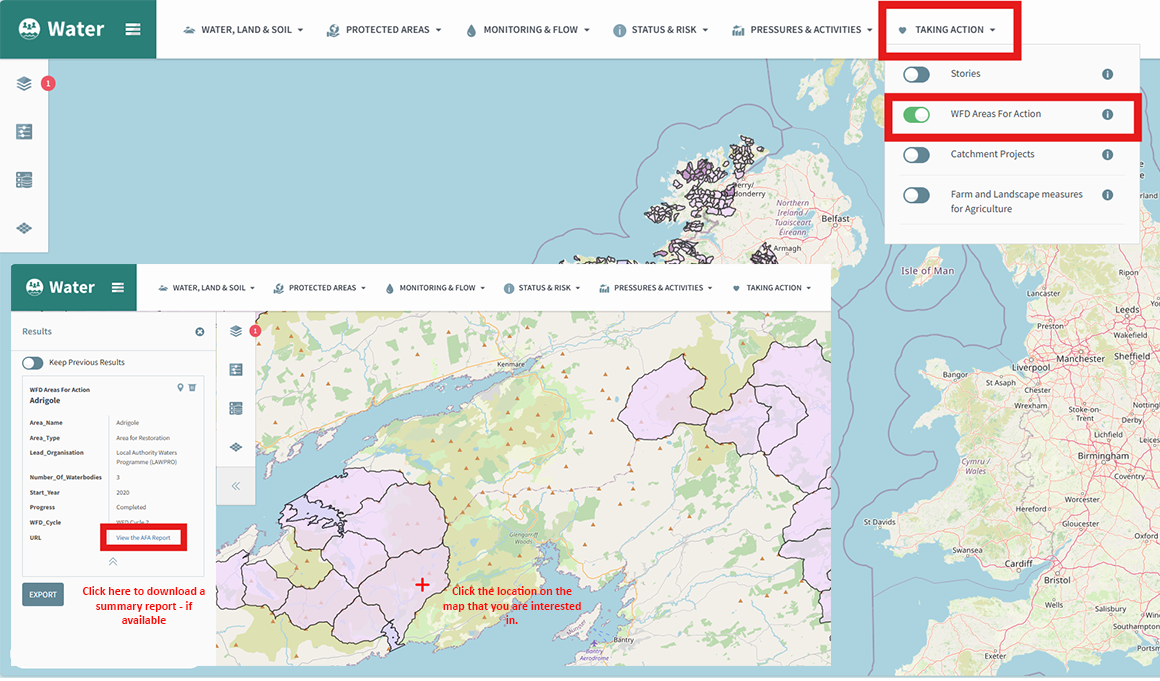
If you wish to search for progress based on location, follow these instructions:
- Click on the link below
- Select “Taking Action” from the top menu
- Turn on the “WFD Areas For Action” layer
- Click on the layer for the location you are interested in
- The left hand side of the map will expand with information for the location you selected. (You may need to press the two down arrows to make the information visible)
Selection process for 3rd Cycle Areas for Action
The third cycle (2022–2027) River Basin Management Plan introduced a broader framework for Areas for Action to include restoration, protection, and catchment projects. These areas were chosen to focus resources where they can make the greatest impact on water quality and to ensure “a place in the plan for everyone.”
Selection built on the second cycle’s Priority Areas for Action (PAAs) but evolved to capture a wider range of catchment management activities. The process considered:
- Water bodies at risk of failing to meet Water Framework Directive objectives
- Protected areas such as drinking water sources, bathing waters, and high-status (Blue Dot) sites
- Practical catchment scale (i.e. sub-catchments) was considered to allow multiple pressures to be managed together for more effective delivery.
- Opportunities for synergies with other environmental actions and projects, ensuring coordinated investment and shared benefits.
The shortlist was developed collaboratively by the EPA, LAWPRO, and the five Regional Operational Committees (ROCs), and formally approved by the five Regional Water and Environment Management Committees (RMCs). LAWPRO then submitted the proposed Areas for Action to the Department of Housing, Local Government and Heritage in May 2021.
The report on the methodology for selection of the Proposed Areas for Action can be viewed here: National Area for Action Report
Selection Process for the 2nd Cycle 2018 – 2021
The process to select the Priority Areas for Action used several principles. The most important one was that water bodies should be At Risk of not achieving good or high water quality. It means that we are working in areas where water quality improvements need to be made. It also gave priority to following type of waterbodies:
- High status objective waterbodies, more commonly referred to as Blue Dot waters
- Waterbodies in Protected Areas, that is waters that are used for drinking water supply, bathing, shellfish growing or waters that feed into habitats in Natural Heritage Areas (NHAs) and Special Areas of Conservation (SACs)
- Waterbodies where the water quality has got worse or might worsen if we do not find the source of pollution
The number of water bodies needed to be reduced, so the following additional principles were used :
- Examine the water bodies where the river rises (headwaters) first
- The PAA should include water bodies at a sub-catchment scale, where practical
- Tackle multiple pollution sources together
- Link the catchment areas to existing programmes and community group initiatives, where possible
- PAAs should build on improvements or measures already planned
- The PAAs should ensure an even distribution of actions to address different pollution sources and catchment types across the regions
Regional Management Committees agreed the list of proposed Priority Areas for Action. A short public consultation process followed it.
The reasons these AFAs were selected is here: Areas for Action – reasons for selection
Local Catchment Assessment is the term used to describe the work LAWPRO do in each of the Priority Areas for Action. To find out more, click here: Our Catchment Work – Local Authority Waters Programme
Learn more

Water Action Plan 2024: A River Basin Management Plan for Ireland
Sets out Ireland’s roadmap for water quality improvements to 2027. It details measures for restoration and protection, sectoral work plans, governance structures, and commitments to integrated catchment management, ensuring the right actions happen in the right place at the right time.
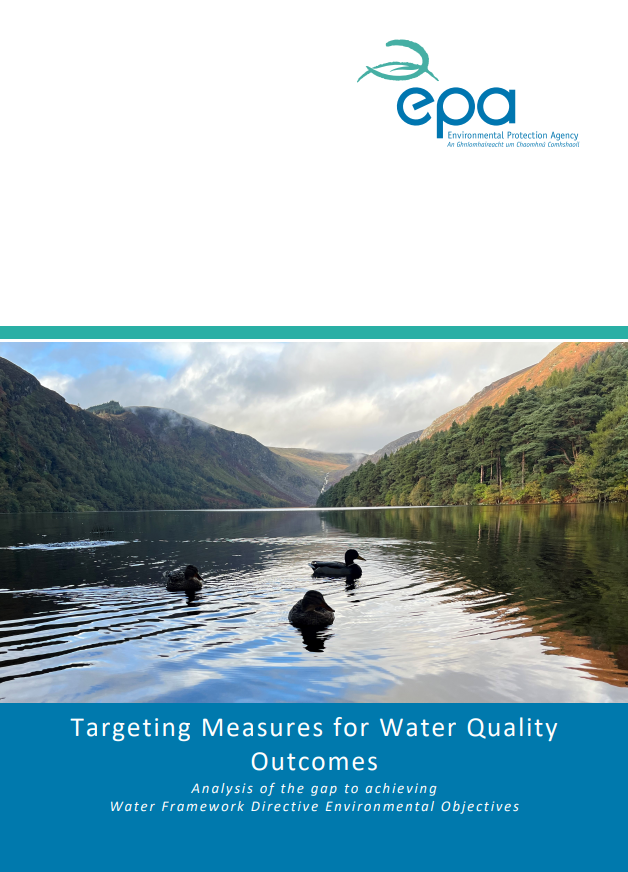
EPA: Targeting Measures for Water Quality Outcomes
Analyses gaps in achieving Water Framework Directive objectives. Highlights three key challenges—measures, effectiveness, and evidence—and provides recommendations for better targeting, monitoring, and reporting to close these gaps and deliver improved water quality outcomes nationally.

Proposed Areas for Action –
3rd Cycle Draft River Basin Management Plan
2022 – 2027
Explains how Areas for Action were selected for the 2022–2027 cycle. Outlines the methodology, governance process, and categories (Restoration, Protection, Catchment Projects) to ensure collaborative, catchment-based delivery of water quality improvements across Ireland.
Who is involved?
Quite simply, everyone in Ireland has a role to play. This can be from something as simple as making sure you don’t pollute your local stream, or a local community working together to establish a Rivers Trust to enhance the rivers and lakes in their area, to a Government Department or Agency helping a Minister implement a new policy to help protect and enhance all our water bodies.
This website has been developed and is maintained by the Environmental Protection Agency, and is a collaboration between the Department of Housing, Planning and Local Government, the Environmental Protection Agency, and the Local Authority Waters Programme.

Local Authority Waters Programme
The Local Authority Waters Programme coordinates the efforts of local authorities and other public bodies in the implementation of the River Basin Management Plan, and supports local community and stakeholder involvement in managing our natural waters, for everyone’s benefit.
Environmental Protection Agency
The EPA is responsible for coordinating the monitoring, assessment and reporting on the status of our 4,842 water bodies, looking at trends and changes, determining which waterbodies are at risk and what could be causing this, and drafting environmental objectives for each.

Department of Housing, Local Government and Heritage
The Department is responsible for making sure that the right policies, regulations and resources are in place to implement the Water Framework Directive, and developing a River Basin Management Plan and Programme of Measures to protect and restore our waters.