

Freshwater Pearl Mussel Plans 2009-2015
Description
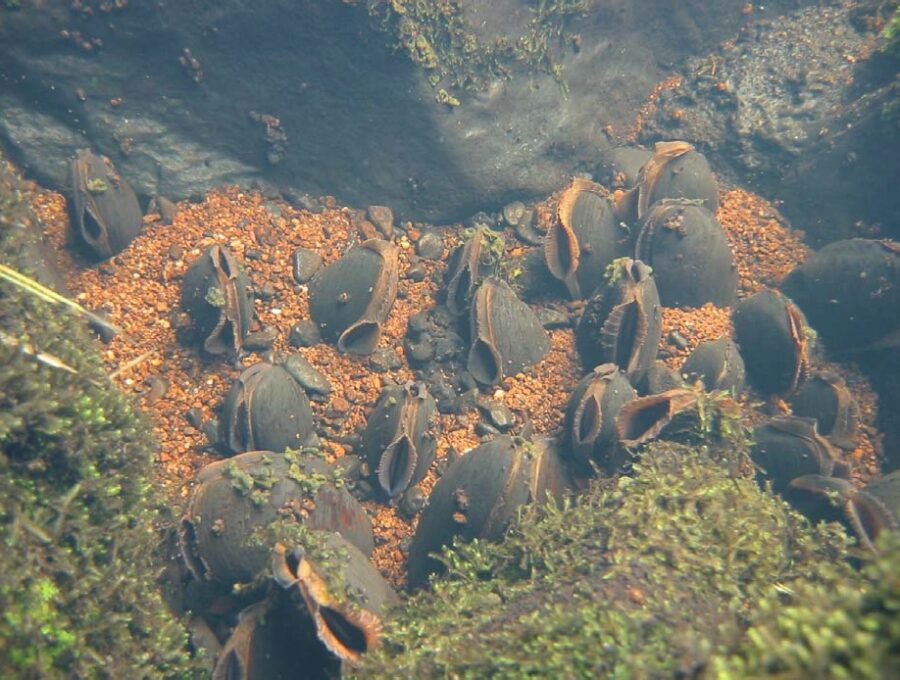
The freshwater pearl mussel is a bivalve, which is a type of mollusc or snail with a body that is almost completely enclosed between a pair of shells. For most of its life it is a filter feeder, and large quantities of water are pumped through the animal’s siphons and food particles are trapped and passed to the mussel’s mouth.
The adult pearl mussel burrows to two-thirds of its shell depth, and is almost sessile in nature, often not moving for 100 years. There are two types of pearl mussels in Ireland, one called Margaritifera margaritifera and the other is the very rare Margaritifera durrovensis, which is only known from the Nore Catchment.
The pearl mussel Margaritifera margaritifera has attracted a lot of interest in recent years due to its interesting ecology, life cycle, ability to produce pearls and, most importantly, its decline which has left the species in danger of extinction.
As their name suggests, Margaritifera has the ability to occasionally produce pearls. However, there is currently no sustainable way to extract pearls (Moorkens 2004), and thus pearl fishing is illegal. This was not always the case, when pearl mussel populations were very abundant the pearl fishery was highly prized, and has been cited as the underlying reason for the invasion of Britain by the Romans (Johnston, 1850). When adult numbers were very high in certain rivers, pearls were an important cultural aspect of the river (Lucey 2005).
Populations of Margaritifera margaritifera are known from North America, northern, western and central Europe and Russia. The species is in very serious decline throughout its range and is listed in the IUCN red data book as endangered worldwide.
These plans for Irish Freshwater Pearl Mussels were prepared as part of the 1st Cycle of River Basin management Plans for 2009-2015.
Categories & Tags
Similar Downloads
About author