
Early insights into river nitrogen levels indicate an increase in…
Early insights indicator report: Nitrogen concentrations in selected major rivers, January – December 2025
River nitrogen levels increased in 2025
Key points
- Nitrogen concentrations in rivers increased by 10% in 2025, based on data from 20 representative monitoring sites. Nitrogen levels in the south‑eastern half of the country are too high to support good ecological health in our water bodies.
- The primary source of nitrogen in Irish rivers is agriculture, from excess losses of nitrogen in chemical and organic fertilisers.
- Nitrogen levels in rivers change due to a combination of factors, including nitrogen inputs, agricultural land management practices and weather patterns.
- Targeted agricultural measures are required to reduce nitrogen losses and achieve improvements in water quality.
Early Insights Nitrogen Indicator Report
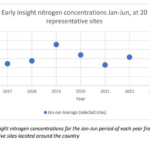
The Environmental Protection Agency (EPA) has published its Early Insights Nitrogen Indicator Report, which provides the latest assessment of nitrogen levels in Ireland’s major rivers for the period January to December 2025. The report shows that average annual nitrogen concentrations at 20 representative monitoring sites increased by 10% in 2025 compared with 2024. This is consistent with earlier findings of elevated nitrogen levels during the January–June 2025 period.
Nitrogen levels remain elevated across the south‑eastern half of the country, where agriculture is the primary nitrogen source. Sustained and targeted action to reduce nitrogen losses is required in the higher‑risk agricultural areas, where the farming intensity is relatively high and the soils are freely draining. The EPA’s Farm and Landscape Measures for Agriculture (FLAG) map identifies these high‑risk areas and can be used to help target action. Targeted actions are needed to support improvements in aquatic ecological health and improve overall water quality.
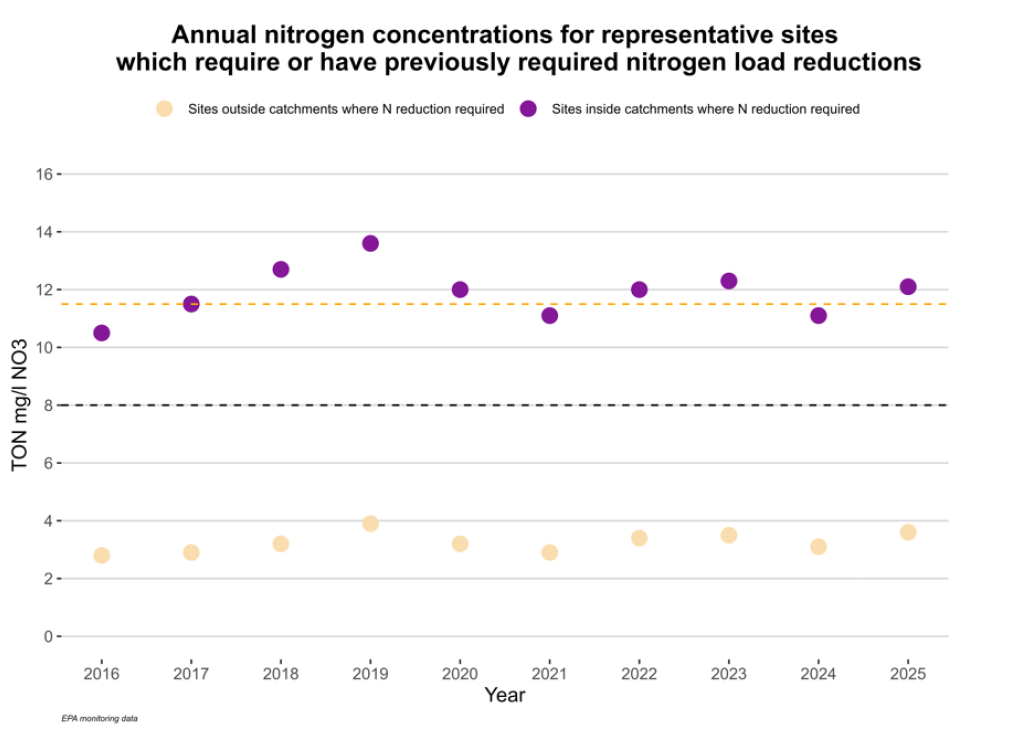
around the country, categorised by catchment type. The estuarine standard of 11.5 mg/l NO3 (2.6 mg/l as N), and the guideline value to support healthy river systems of 8 mg/l as NO3 (1.8 mg/l as N) are included.
Commenting on the report, Pat Byrne, Director of the EPA, Office of Evidence and Assessment, said:
“The Early Insights Nitrogen Indicator provides timely evidence on how nitrogen concentrations in our rivers are changing. The increase observed in 2025 highlights the continued pressure on water quality and underlines the need for sustained, targeted action to reduce losses of nitrogen used in agriculture, particularly in higher‑risk catchments in the southeastern half of the country.”
Learn more
The Early Insights Nitrogen Indicator Report: Nitrogen concentrations in selected major rivers, January–December 2025 is available on the EPA website. Further information on local water quality, including the FLAG map to help target agricultural measures is available here.
The EPA undertakes a full assessment of the overall quality and ecological status of Ireland’s waters every three years. The latest full assessment was published in October 2025 on the EPA website.
The EPA also publishes water indicator data for over 1000 monitoring points from the national water monitoring network, on an annual basis. The latest report on Nitrogen and phosphorus concentrations in Irish waters 2024 was published in July 2025.
In 2021 and 2025, the EPA published an assessment on the nitrogen reductions that were needed in major catchments to support healthy aquatic ecosystems. The most recent assessment can be found here and included data up to 2024.
Related Posts
About author