

How do you get from ‘A’ to ‘B’? If ‘A’…
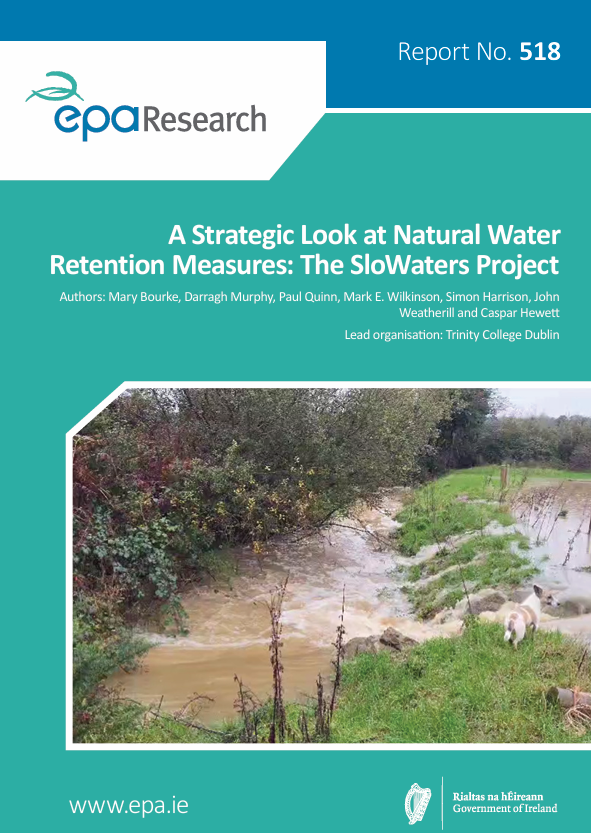
Research; A Strategic Look At Natural Water Retention Measures: The SloWaters Project
This TCD research addressed growing flood risk and reduced water quality in Ireland, driven by climate change and intensive agriculture, by providing the first empirical evidence of Nature-based Solutions (NbS) in rural landscapes.
Demonstration sites tested measures such as offline storage areas, leaky dams and woodland swales. Advanced modelling tools assessed the impact of these measures on flood attenuation and water quality. Results showed that NbS can reduce runoff, temporarily store floodwater, lower nitrate concentrations and complement traditional engineering approaches. Engagement with stakeholders informed practical resources, including modelling tools, a literature database and an interactive story map.
What did the research aim to address?
The SloWaters project addressed the pressing environmental challenges of flooding and declining water quality in Ireland, which are being exacerbated by climate change and intensive agricultural practices. It fills a critical knowledge gap: the lack of empirical evidence regarding the effectiveness of nature-based solutions (NbS) in Irish rural landscapes. This research is crucial for policymakers, farmers and local communities, and provides a sustainable, low-cost framework for protecting infrastructure and restoring ecosystems. The approach is innovative, as it is the first project in Ireland to construct rural demonstration sites (in Wexford and Cork) specifically designed to test NbS measures, such as offline storage areas and leaky dams. By integrating these field experiments with advanced numerical modelling (including the Pond Forensic Model and the Catchment Runoff Attenuation Flux Tool), the project provides a multifaceted evidence base to attenuate surface runoff and floodplain inundation. This research
underscores the potential for NbS to complement traditional engineering in achieving climate-resilient catchment management.
What did the research find?
This work advances the state of the art by moving beyond theoretical modelling to real-world construction and instrumentation in Ireland. The research demonstrates that NbS are highly effective in Irish agricultural catchments. The findings address the primary evidence gap by providing the
first Irish empirical data on rural NbS performance, including offline temporary storage areas and inundated woodland swales, which significantly reduced nitrate concentrations. There is ample space in the farmed landscape for temporary floodwater storage (for 6–12 hours). Increasing floodwater storage capacity in the farmed landscape will have a big impact on larger flood events. Societal and policy relevance is underscored by extensive stakeholder engagement, with over 200 visitors, including farmers, politicians and media, visiting the demonstration sites. Beyond experimental data, outputs include an online literature search tool and an interactive story map of natural water retention measures to assist practitioners. While evidence for the efficacy of NbS at larger catchment scales (> 100 km²) and more extreme events is beginning to emerge, the evidence base remains limited to frequent, low-magnitude floods in small catchments. Case studies in Ireland are needed at the catchment scale. In addition,
the finding that a measure at one site occasionally acted as a phosphorus source needs further testing and suggests that designs must be carefully tailored to local conditions.
How can the research findings be used?
The findings provide a framework for mainstreaming NbS into Irish flood risk management. A critical next step is the explicit integration of NbS into national policy alongside traditional engineering, moving beyond recognition to mandatory feasibility in all flood relief schemes. Future implementation requires establishing a dedicated, long-term funding stream to encourage uptake by private landowners for the provision of these ecosystem services. Farmers must be centred in any discussions of NbS governance, implementation and payment schemes. The project’s modelling tools and demonstration sites can be used to design “treatment train” networks of NbS features alongside bespoke training
for land managers and advisors. Future research should focus on the performance of NbS during extreme events, and the social and liability concerns of private landowners. It should also address unfavourable phosphorus dynamics where they occur. One possible approach would be to design water quality features and flood storage features differently, but to co-locate them in complementary parts of a farm plan. Strategic monitoring of existing sites (e.g. floodplain ponds) will strengthen the empirical database, facilitating the transition from a “no NbS until quantified” approach to an adaptive “learn by doing” approach for climate-resilient catchment management.
Learn more
Research Publications | Environmental Protection Agency
Related Posts

About author