The latest issue of the Catchments Newsletter is now available…
Catchments Newsletter – Issue 18: Autumn 2026
The latest edition of the Catchments Newsletter captures the inspiring work happening in communities, farms, rivers and waterways nationwide. From catchment restoration projects and innovative water quality initiatives to citizen science and environmental research, Issue 18 showcases the people and projects making a real difference on the ground.
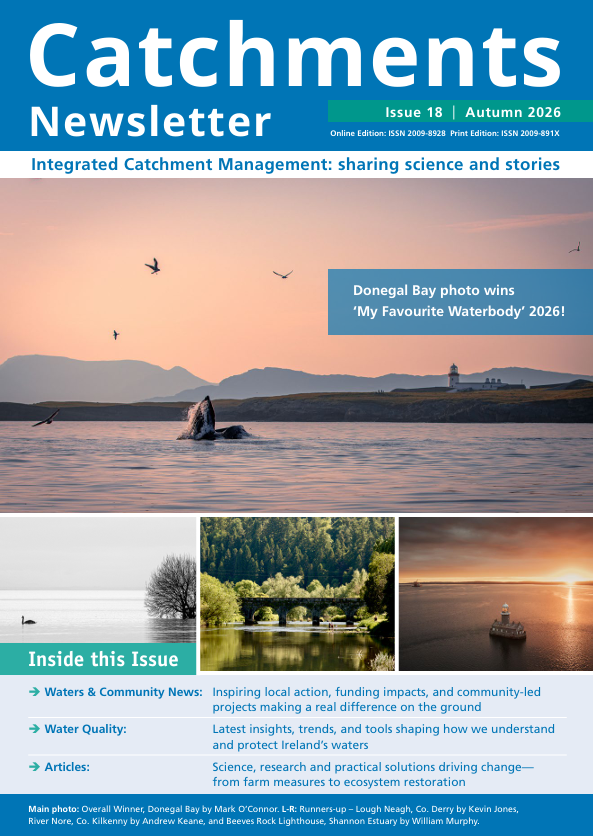
Inside this issue
- Waters & Community News: Inspiring local action, funding impacts, and community-led projects making a real difference on the ground
- Water Quality: Latest insights, trends, and tools shaping how we understand and protect Ireland’s waters
- Articles: Science, research and practical solutions driving change— from farm measures to ecosystem restoration
Have a story to tell? We’re always looking for inspiring stories that connect people, communities and water. Get in touch via www.catchments.ie/contact
Editorial
Welcome to the latest edition of the Catchments Newsletter. This issue comes at a time when water quality remains firmly in focus across Ireland. Recent assessments show that while there have been improvements in some areas, significant challenges remain in protecting and restoring our rivers, lakes, estuaries and coastal waters. The picture is mixed, reminding us that improving water quality is a long-term effort that requires continued commitment from all of us.
Across the country, however, there is no shortage of people taking action. Farmers, communities, local authorities, researchers, State agencies and environmental organisations are all working to better understand the pressures on ourwaters and to identify practical solutions. Every year, we see more examples of collaboration, innovation and local leadership making a positive difference.
That spirit of collaboration runs throughout this edition. From catchment restoration projects and community initiatives to scientific research, citizen science, farming innovations and nature-based solutions; the stories featured here highlight the commitment and expertise that exist across the country. They also remind us that water quality is fundamentally a local issue. The choices we make on our farms, in our communities, around our homes and through our public services all contribute to the health of our waters.
The challenge now is not understanding what needs to be done. The challenge is accelerating implementation and scaling up the actions that we know work.
Clean water underpins our environment, our economy, our biodiversity and our quality of life. Protecting and restoring it is a shared responsibility. The examples showcased in this newsletter give every reason to believe that, by working together and acting with urgency, we can make meaningful progress towards healthier waters for future generations.
Thank you to everyone contributing to that effort.
Read more
Our Catchments Newsletter brings together science and stories from community groups, local authorities, public bodies, researchers, the EPA and the Local Authority Waters Programme, and others about the different ways we all work together to care for Ireland’s rivers, lakes, streams and coastal waters so they can be protected, and restored where necessary.
EPA published reports and guidance documents on Monitoring and Assessment: Freshwater & Marine. Monitoring & Assessment: Freshwater & Marine Publications | Environmental Protection Agency
Note: While every effort is made to ensure the accuracy of information presented, new data and insights are continually emerging. We will continue to share updated findings as they become available.
Related Posts
About author