
Early insights into river nitrogen levels indicate an increase in…
Early insights indicator report: Nitrogen concentrations in selected major rivers, January – June 2026
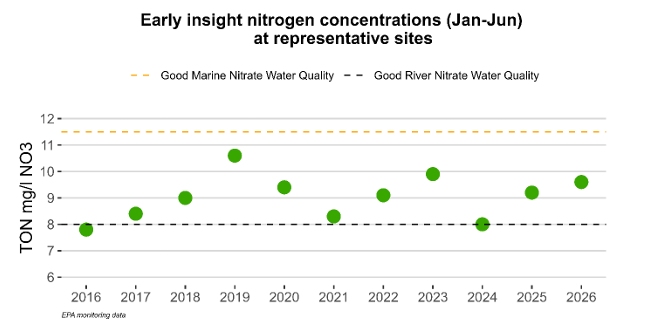
Early insights into river nitrogen levels indicate a further increase in the first half of 2026.
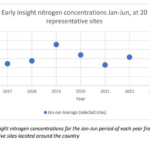
The Environmental Protection Agency (EPA) has published the Early Insights Nitrogen Indicator Report for the first six months of 2026. The report provides timely information on nitrogen levels in Ireland’s major rivers. It is based on monitoring data from 20 representative river monitoring sites across the country.
The report shows that nitrogen levels increased by 4.3 per cent in the first half of 2026 compared with the same period in 2025. This marks a second consecutive year of increasing nitrogen concentrations in Ireland’s major rivers.
Nitrogen concentrations remain highest in catchments in the east, south and south-east of the country. Agriculture is the primary source of nitrogen in these areas. The report highlights the need for targeted and sustained measures in these higher-risk areas. These actions can help reduce nitrogen losses and improve water quality. The EPA’s Farm and Landscape Measures for Agriculture (FLAG) map helps identify where action is needed most. It also highlights the measures most likely to deliver improvements.
The findings from this Early Insights report highlight current trends in river nitrogen levels. They will help guide efforts to improve water quality. National monitoring data will support work on the next Water Action Plan and help target measures to reduce nutrient losses. These actions will help protect Ireland’s rivers, lakes and estuaries. The next Early Insights Nitrogen report, covering July to December 2026, is scheduled for publication in March 2027.
The findings of this report complement the EPA’s wider water quality monitoring and assessment programme. The EPA published Water Quality in Ireland 2019-2024 in 2025. Alongside this assessment, the EPA continues to publish annual indicator reports and Early Insights reports that track changes in water quality and nutrient concentrations across Ireland.
Learn More
The latest edition of the Early Insights Nitrogen Indicator Report, covering January to June 2026. It is available on the EPA website: https://www.epa.ie/publications/monitoring–assessment/freshwater–marine/early-insights-indicator-report-nitrogen-concentrations-in-selected-major-rivers-january-june-2026.php
Further information on local water quality, including the FLAG map to help target agricultural measures, is available here.
A series of Early Insights indicator reports has been published since 2024. This outlines the development of the indicator and the representative monitoring sites used to assess nitrogen concentrations in Ireland’s major rivers. The previous report, covering January to December 2025, provides further information on recent nitrogen trends and can be viewed here
Catchment-level information on water quality is available here.
Related Posts
About author